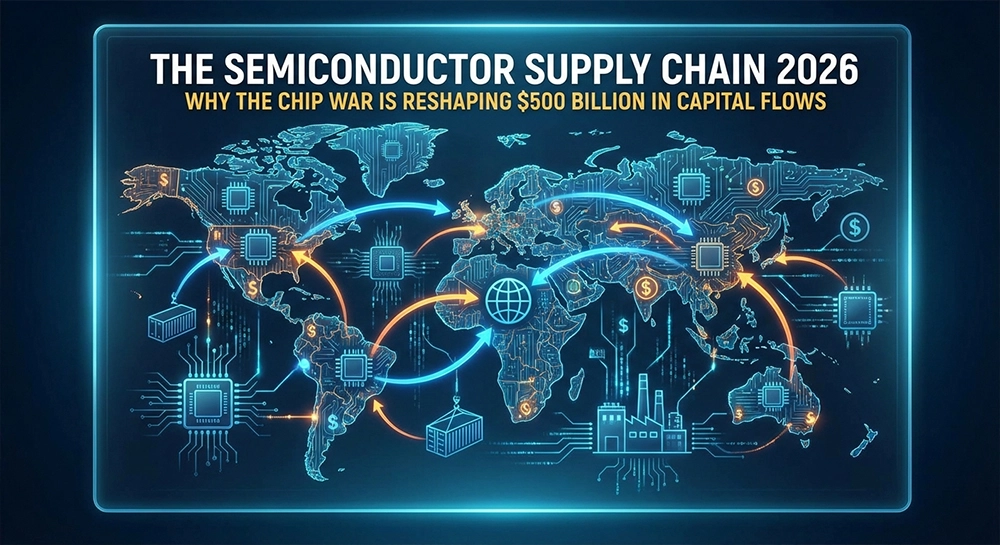
For the last half-century, the semiconductor industry operated on a simple logic: design in America, manufacture in Taiwan, assemble in China, and sell globally. That era is over. In 2026, the world is witnessing the most dramatic restructuring of the chip supply chain since the invention of the integrated circuit. Geopolitics, national security paranoia, and the insatiable appetite of artificial intelligence have converged to trigger a $500 billion capital reallocation—the largest peacetime industrial policy mobilization in modern history.
This is not a temporary trade skirmish. This is the rewiring of the global technology stack. For investors in 2026, the semiconductor story has split into two distinct narratives. The first is the "AI demand" story—familiar and largely priced in. The second is the "supply chain sovereignty" story—less glamorous, deeply political, and massively under-appreciated by public markets.
The CHIPS Act: From Subsidy to Industrial Complex
The U.S. CHIPS and Science Act allocated $52 billion in subsidies and tax credits to rebuild domestic semiconductor manufacturing. By early 2026, that money is concrete, steel, and cleanrooms rising across the American Southwest and Midwest.
Intel is building two massive fabs in Ohio, with groundbreaking for two more in Arizona. TSMC has committed to three fabs in Arizona. Samsung is expanding in Texas. Micron is building a new memory fab in upstate New York. Over $200 billion in private capital is being deployed alongside government subsidies.
These fabs are being built not because they are the cheapest place to manufacture—they are not—but because they are the safest. A Chinese blockade of Taiwan would instantly sever 90% of the world's advanced logic chip supply.
Investment Implication: The "reshoring premium" is real. ASML, the Dutch monopoly on extreme ultraviolet (EUV) lithography machines, trades at a 35x P/E despite being a capital equipment company. Governments will not let ASML fail.
The Equipment Makers: The Hidden Oligopoly
The real power brokers in the semiconductor supply chain are the equipment manufacturers. This is an oligopoly so concentrated it makes OPEC look competitive.
ASML (Netherlands): 100% monopoly on EUV lithography. Each machine costs $200 million, weighs 180 tons, and takes 18 months to build. There is no Plan B.
Applied Materials (U.S.) and Lam Research (U.S.): Dominate deposition and etching with 70%+ market share in their niches.
Tokyo Electron and Hitachi High-Tech (Japan): Control key inspection and metrology equipment.
Every new fab—whether in Arizona, Germany, or Japan—must buy the same machines. Approximately 60-70% of a $20-30 billion fab's capex goes to equipment purchases. With 20+ major fabs under construction globally, equipment orders are at all-time highs.
Memory Chips: The Forgotten Boom
Memory chips—DRAM and NAND flash—are the silent workhorses of the digital economy. In 2026, the memory market is experiencing a structural bull run driven by AI's insatiable bandwidth requirements.
High Bandwidth Memory (HBM)—specialized DRAM stacked vertically to feed GPUs—is sold out through 2027. SK Hynix leads, with Micron and Samsung racing to catch up. HBM commands a 4-5x price premium over standard DRAM. Gross margins have expanded from low 30% to over 50%.
Micron Technology (MU) is the investment story here. As the only major U.S.-based memory manufacturer, it is receiving CHIPS Act subsidies and Pentagon support for "secure" memory for defense applications.
AI is not a cyclical demand driver; it is a structural step-function increase in memory consumption. Every next-generation GPU cluster requires exponentially more HBM.
The Packaging Revolution: Chiplets and 3D Integration
As Moore's Law slows, the industry has pivoted to advanced packaging—stacking and integrating multiple chips into a single high-performance module. AMD pioneered this with EPYC server processors and MI300 AI accelerators. Intel is betting on "Foveros" 3D packaging. TSMC offers CoWoS and SoIC as foundry services.
The winners are the OSAT companies—ASE Technology, Amkor Technology, and JCET. Advanced packaging can add $200-500 per unit in value. Amkor is constructing a $2 billion advanced packaging facility in Arizona, adjacent to TSMC's fab.
The China Wildcard: Self-Sufficiency at Any Cost
China is pursuing semiconductor self-sufficiency with wartime intensity. SMIC has produced 7nm-class chips despite being cut off from EUV machines, using brute-force multi-patterning. Chinese equipment makers NAURA and AMEC have achieved 14nm-level capability.
The greatest risk is not that China catches up technologically, but that China builds a parallel "good enough" supply chain for mature chips (28nm and above), which account for 70% of chip volume. If China exports aggressively, it could crater pricing for legacy fabs globally.
The Analog and Power Semiconductor Sleeper
Texas Instruments and Analog Devices are the blue-chip aristocrats of analog/power chips—high margins, low volatility, fortress balance sheets. The real opportunity is in power semiconductors for electrification. ON Semiconductor and Wolfspeed are building out silicon carbide (SiC) capacity—far more efficient for EV inverters and solar inverters.
SiC is in structural shortage. Lead times are 40+ weeks. The U.S. and Europe have a real shot at leadership here.
Valuations: Expensive, But Not Irrational
The SOX Index is up over 200% from 2022 lows. But sector-wide earnings growth is projected at 25%+ for 2026. NVIDIA trades at 35x forward earnings—reasonable for 40%+ growth with 70% gross margins. ASML at 35x is a geopolitical asset, not just a business. Micron at 12x forward earnings is outright cheap.
Portfolio Construction: The Semiconductor Pyramid
Tier 1 – The Untouchables (40%): NVIDIA, ASML, TSMC. Essential monopolies.
Tier 2 – The Enablers (30%): Applied Materials, Lam Research, Tokyo Electron, Micron.
Tier 3 – The Specialists (20%): Amkor (packaging), ON Semiconductor (SiC power), Axcelis (ion implantation).
Tier 4 – The Hedges (10%): Texas Instruments, Analog Devices. Defensive, stable.
The Conclusion: Chips Are the New Steel
In the 20th century, steel production was the ultimate measure of industrial power. In the 21st, it is semiconductors. The nation that controls chip production controls the commanding heights of the economy: AI, defense, communications, energy, transportation.
In 2026, the chip war is not a trade dispute—it is a contest for technological supremacy. The U.S., Europe, Japan, and their allies are spending unprecedented sums to secure supply chains. China is pursuing autarky at any cost. Taiwan sits in the middle, the most strategically valuable piece of real estate on Earth.
For investors, this is about understanding that semiconductors have become infrastructure—critical, subsidized, and politically protected. The returns will be less explosive than 2023's AI mania, but far more durable.
The chip war is just beginning. And the winners are already being chosen—not by markets, but by governments.