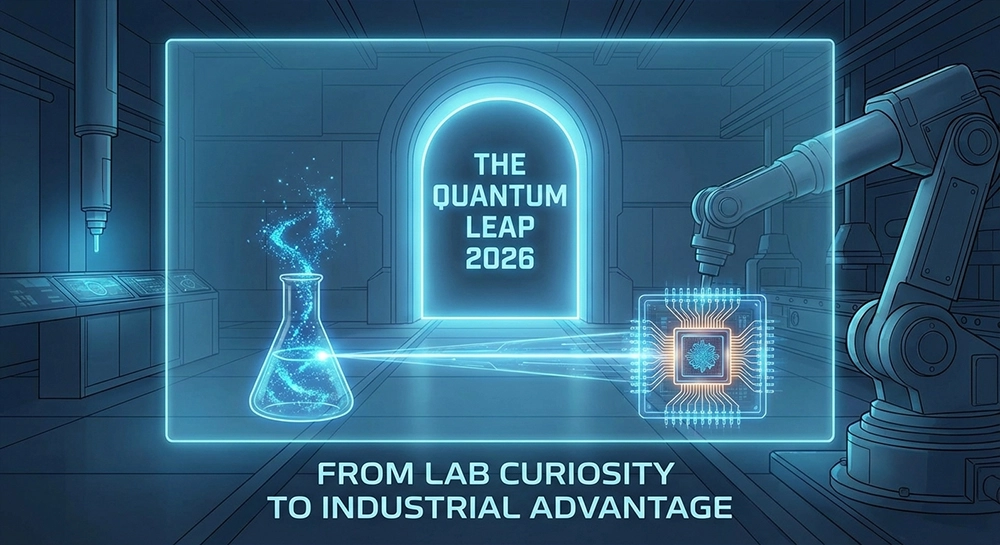
For forty years, quantum computing was the "forever away" technology—a physics experiment perpetually twenty years in the future. In 2026, the timeline has collapsed. We have officially entered the "Quantum Utility" era. This is the moment when quantum computers stop being scientific novelties used to simulate simple molecules and start solving commercial problems that are mathematically impossible for classical supercomputers.
The shift is subtle but seismic. It is not about replacing your laptop or even the cloud. It is about the emergence of a specialized, exotic computational layer designed to crack the three hardest problems in industry: optimization, simulation, and cryptography.
As we navigate the investment landscape of 2026, the quantum sector resembles the internet in 1993 or AI in 2012. The underlying hardware is stabilizing, the software stack is maturing, and the first "killer apps" are moving from proof-of-concept to production. For the astute investor, this represents the ground floor of a market McKinsey projects will create $1.3 trillion in value by 2035.
The Hardware Race: The "Qubit" Standard Emerges
The central metric of the quantum race is the Logical Qubit. Unlike a physical qubit (noisy and error-prone), a logical qubit is error-corrected and stable. In 2025, the industry crossed the "Threshold Theorem" in practice—demonstrating that we can suppress errors faster than they occur.
1. Superconducting Qubits: The IBM and Google Juggernaut
IBM has deployed its "Kookaburra" processor, achieving 10,000+ gates of coherent quantum volume. Their "Quantum System Two" modular architecture has made them the de facto standard for enterprise access, with 250+ Fortune 500 partners.
Google (Alphabet) remains the leader in "Quantum Supremacy" demonstrations. Their Sycamore architecture performs tasks in seconds that would take Frontier (the world's fastest supercomputer) 47 years.
Investment Angle: Rigetti Computing (RGTI) offers pure-play exposure. Their 84-qubit Ankaa-3 system has found a niche in hybrid quantum-classical workflows.
2. Trapped Ions: The Precision Kings
IonQ (IONQ) is the market leader. In 2026, IonQ achieved 64 Algorithmic Qubits—the "commercial advantage" threshold where the system can model chemical interactions complex enough to interest pharma giants. With a manufacturing facility in Seattle churning out rack-mounted quantum computers, IonQ is the first to transition from "lab bench" to "data center appliance."
Quantinuum (majority-owned by Honeywell) is the dark horse. Their H2 processor holds the world record for "quantum volume." Rumors of a 2026 IPO are driving massive interest in private markets.
3. Neutral Atoms: The Scaling Surprise
The breakout star of 2026 is neutral atom computing. By using optical tweezers to arrange atoms in 3D arrays, QuEra Computing and Pasqal have demonstrated 1,000+ qubit systems. Their massive scale makes them perfect for analog optimization problems—like optimizing the national power grid or routing 50,000 delivery trucks.
The "Killer App": Simulation is the New Manufacturing
In 2026, quantum revenue comes from Chemistry and Materials Science. Classical computers are terrible at simulating nature because nature is quantum.
Pharma 4.0: Roche, Merck, and Pfizer are paying customers of quantum cloud services. They are simulating "ligand-protein binding"—the specific moment a drug attaches to a cell. If quantum simulation improves the "hit rate" of pre-clinical drug candidates by just 10%, it saves $200 million and two years per drug.
NVIDIA's Role: The CUDA-Q platform allows researchers to simulate quantum circuits on classical GPU clusters before running on real hardware. NVIDIA is the shovel seller in the quantum gold rush.
Materials & Batteries: Volkswagen and Daimler are using quantum algorithms to simulate lithium-ion battery degradation at the atomic level, seeking cathode materials that extend EV range by 20%.
The Cryptography Crisis: Q-Day is Coming
A sufficiently powerful quantum computer (4,000+ logical qubits) can crack RSA encryption—the math that protects every bank account, email, and nuclear launch code on Earth. While likely 5-7 years away, "Harvest Now, Decrypt Later" attacks are happening today.
NIST finalized Post-Quantum Cryptography (PQC) standards in 2024. In 2026, every federal agency, defense contractor, and bank is under mandate to migrate. Palo Alto Networks, Cloudflare, and CrowdStrike are selling "Quantum Readiness" modules.
SandboxAQ (Alphabet spinoff) is the leader in PQC migration. It's essentially Y2K remediation for encryption—a multi-billion dollar consulting boom.
Financial Services: The Optimization Edge
JPMorgan Chase and Goldman Sachs have dedicated quantum teams for portfolio optimization and fraud detection. D-Wave Quantum (QBTS) uses "quantum annealing" for optimization. Their 7,000-qubit Advantage2 system routes port traffic in Los Angeles and Rotterdam, proving that "limited" quantum is still profitable.
The Geopolitical Dimension: Export Controls 2.0
The U.S. government has placed quantum technology under the strictest export controls in history. China is pouring unlimited state capital into its national quantum lab in Hefei, leading in Quantum Communications with the Micius satellite demonstrating unhackable QKD from space.
The Western supply chain (US, UK, Canada, Australia, Japan) is integrating rapidly. AUKUS Pillar II is driving defense funding into companies like PsiQuantum.
The Supply Chain: Picks, Shovels, and Fridges
Keysight Technologies (KEYS): Makes electronic control systems and probe cards. Their quantum engineering solutions group is growing at 40% CAGR.
Coherent (COHR) and Lumentum (LITE): Critical for photonic and trapped-ion approaches. These systems require highly specific lasers and optical modulators.
Investing in the supply chain is often safer than picking individual quantum hardware winners.
Portfolio Strategy 2026: The Quantum Basket
You cannot pick a single winner yet. A "Quantum Basket" approach is required.
The Pure Plays (High Beta):
- IonQ (IONQ): Best-in-class execution, strong balance sheet. The "blue chip" of pure plays.
- Rigetti (RGTI): The value play. High risk, but deep government integration.
- D-Wave (QBTS): The revenue play. Actual commercial customers.
The Strategic Tech Giants (Safe Harbor):
- IBM (IBM): The quantum leader with the world's biggest quantum cloud.
- Alphabet (GOOGL): Quantum as a call option on AI dominance.
- Microsoft (MSFT): Azure Quantum wins regardless of who wins hardware.
The ETF Route: Defiance Quantum ETF (QTUM) provides broad exposure across hardware makers, supply chain, and end-users.
Conclusion: The Asymmetric Bet
In 2026, Quantum Computing is not for the faint of heart. It is for the patient. We are at the inflection point where the technology transitions from "Science" to "Engineering."
The upside is asymmetric. If AI is a tool that helps us analyze the world, Quantum is a tool that helps us simulate the world at its most fundamental level. It unlocks the ability to design materials that don't exist, cure diseases we can't model, and optimize systems that are currently chaotic.
The market is currently pricing these stocks as "unprofitable tech." It is not yet pricing them as "strategic national assets." That gap is your opportunity. When the first "Quantum Advantage" application goes into production—likely in drug discovery or financial optimization later this year—the repricing will be violent.
The 21st century doesn't truly begin until we master the quantum realm. In 2026, we are finally knocking on the door.