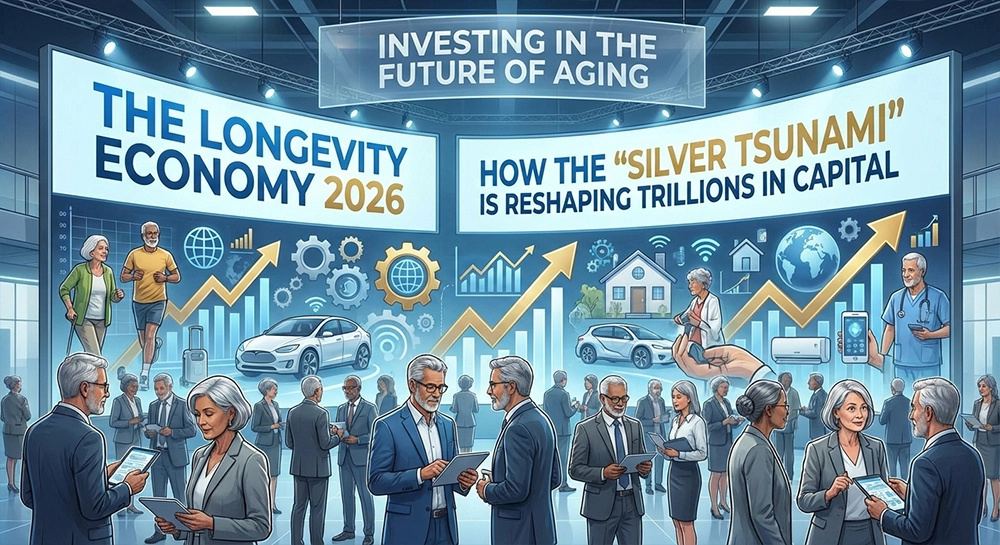
As we navigate the first quarter of 2026, a demographic inevitability has transformed from a distant forecast into a daily economic reality. The "Silver Tsunami"—the mass retirement of the Baby Boomer generation—has crashed ashore. But unlike a natural disaster that destroys value, this tidal wave is creating it. We are witnessing the maturation of the Longevity Economy, a $9 trillion market in the United States alone that is fundamentally rewriting the rules of healthcare, real estate, leisure, and asset management.
For decades, economists warned of the "aging burden." They predicted slower growth, strained pension systems, and a labor crisis. While those challenges are real, the investment narrative of 2026 has flipped. The focus is no longer on the cost of aging, but on the consumption of the wealthiest generation in human history. The youngest Boomers are now turning 62, eligible for Social Security, while the oldest are entering their 80s, triggering peak demand for specialized care.
This is not a niche theme. It is the dominant macro-demographic force of the 2020s. Investors who ignore the spending power and care needs of 73 million older Americans are missing the most predictable growth story in the market.
The Great Wealth Decumulation: From Savers to Spenders
To understand the magnitude of this shift, follow the money. U.S. Baby Boomers hold approximately $78 trillion in assets—over half of the nation's total household wealth. For forty years, this generation was in "accumulation mode," pouring money into 401(k)s, paying off mortgages, and building equity.
In 2026, the switch has flipped to "decumulation."
This psychological and financial pivot is unleashing liquidity into the economy at an unprecedented rate. Unlike their Depression-era parents, Boomers are less inclined to leave every cent to their children and more inclined to enjoy their "third act." This is the era of "Giving While Living"—funding grandchildren's education, buying second homes, and spending lavishly on experiences.
However, the wealth transfer that is happening is accelerating. An estimated $84 trillion will pass from older Americans to Gen X and Millennials over the next two decades. In 2026 alone, hundreds of billions are moving between generations, changing the risk profile of capital.
Investment Implication: Wealth management firms are in a fierce war for retention. Firms like Morgan Stanley and Charles Schwab are pivoting their services from simple asset allocation to comprehensive "longevity planning"—concierge services that cover estate planning, health advocacy, and lifestyle management.
MedTech and the "Bionic" Generation
If the 20th century was about fighting infectious diseases, the 2026 healthcare landscape is defined by "maintenance and mobility." This generation refuses to age passively. They want to play pickleball at 75, hike at 80, and travel at 85. This demand is fueling a supercycle in Medical Technology (MedTech).
We are seeing an explosion in elective procedures. Knee and hip replacements, once reserved for the immobile, are now routine performance enhancements for active seniors. Cataract surgeries with premium lenses, transcatheter heart valve replacements (TAVR), and robotic-assisted surgeries are growing at double-digit rates.
Stryker (SYK) and Boston Scientific (BSX) are the industrial titans of this trend. Their order books for 2026 are filled not just because the population is getting older, but because the definition of "old" has changed.
Furthermore, the integration of AI into MedTech is creating the "Connected Patient." DexCom and Abbott Laboratories have moved beyond diabetes management to general metabolic health monitoring. Wearable biosensors that track heart rhythm (AFib detection), gait stability (fall prevention), and sleep quality are becoming standard equipment for the aging population.
The Alpha Play: Look for companies specializing in "minimally invasive" technologies. Intuitive Surgical (ISRG) remains the gold standard here, but emerging players in robotic orthopedics are gaining market share.
Senior Housing 2.0: The End of the "Nursing Home"
The most dramatic reinvention is happening in real estate. The phrase "nursing home" is toxic to Boomers. They demand "Active Adult Communities," "Wellness Resorts," and "Assisted Living" that feels like a Hyatt Regency, not a hospital.
This bifurcation has created a massive opportunity for specialized REITs. Welltower (WELL) and Ventas (VTR) have spent the last three years reshaping their portfolios, selling off old-school skilled nursing facilities and acquiring high-end senior living properties in affluent coastal markets.
In 2026, the supply-demand imbalance is acute. Construction of senior housing halted during the high-interest rate environment of 2023-2024. Now, as the "Peak 80" wave (the surge of people turning 80+) begins to crest, there are simply not enough beds. Occupancy rates in top-tier facilities have hit 95%, driving rental rate growth of 6-8% annually.
But the trend isn't just about moving out; it's about "Aging in Place." Lowe's and Home Depot have launched "Livability" divisions, offering retrofits—grab bars, walk-in tubs, smart lighting, wider doorways—to make suburban homes safe for seniors.
The Experience Economy: The "YOLO" Retirement
The "Roaring 20s" for the travel industry is being powered by gray hair. In 2026, retirees are the most lucrative demographic for leisure companies. Unshackled from school schedules and work commitments, they travel off-peak, book longer stays, and purchase premium upgrades.
The cruise industry is the primary beneficiary. Royal Caribbean and Viking Holdings report that their highest-spending cohorts are now 60+. These aren't the budget cruises of the past; they are "expedition" voyages to Antarctica, river cruises through Europe, and months-long world tours. The psychology is shifting from leaving an inheritance to "spending the kids' inheritance" (SKI).
This extends to the RV market and hospitality. Marriott and Hilton have launched sub-brands specifically targeting the "active ager," focusing on wellness, culinary experiences, and accessibility.
The Care Crisis and the Robotics Solution
The dark side of the Longevity Economy is the labor shortage. By 2026, the U.S. faces a deficit of 400,000 home health aides and 100,000 nurses. There simply aren't enough humans to care for the aging population. This crisis is the mother of invention for AgeTech.
Investors are pouring capital into robotics and automation that can bridge the care gap. This includes:
Service Robots: Automated delivery carts in hospitals and retirement communities.
Social Robotics: AI-driven companions that combat loneliness and remind seniors to take medication, reducing cognitive decline.
Exoskeletons: Assistive devices that allow caregivers to lift patients without injury, or help seniors maintain mobility.
While still in the early innings, the "CareBot" sector is where AI meets the physical world. It is no longer science fiction; it is an operational necessity for senior living operators trying to maintain margins amidst skyrocketing labor costs.
Financial Services: The Annuity Renaissance
For the financial sector, 2026 is the year of the annuity. For a decade of zero interest rates, annuities were unlovable products with high fees and low returns. Today, with rates normalized, they are the only product that solves the Boomer's #1 fear: outliving their money (longevity risk).
Insurance giants like Apollo Global Management (via Athene), Corebridge Financial, and MetLife are seeing record inflows. They are structuring products that offer guaranteed income streams of 5-6% for life, a proposition that is irresistible to a retiree terrified of market volatility.
This is shifting the power center of Wall Street. Private equity firms are increasingly acquiring insurance float to deploy into private credit, creating a symbiotic loop: Boomers buy annuities → Insurers get cash → Insurers lend to private credit → Boomers get yield. It is the financial engine of the 2026 economy.
Risks to the Thesis
No investment theme is without peril.
Government Solvency: The elephant in the room is Medicare and Social Security. While benefits won't be cut for current retirees, reimbursement rates to providers (hospitals, insurers) are under constant pressure.
The Wealth Gap: The Longevity Economy is a story of the "Haves." The top 20% of seniors are fueling the luxury boom. The bottom 40% are facing a cost-of-living crisis, reliant entirely on Social Security.
Inflation Stickiness: Healthcare costs historically rise faster than general inflation. If medical inflation runs at 6% while retiree fixed income grows at 3%, purchasing power erodes, dampening discretionary spending.
Conclusion: The Long Game
The "Silver Tsunami" is often framed as a societal burden. For the astute investor in 2026, it is a structural tailwind that provides clarity in an uncertain world. We know exactly how many people will turn 80 in 2030. We know what diseases they will have. We know what services they will need.
This predictability is rare.
The winning portfolio for the rest of the decade leans into this inevitability. It owns the MedTech firms keeping them moving, the REITs housing them in style, the Asset Managers securing their income, and the Leisure companies helping them enjoy their twilight years.
The Boomers reshaped the economy when they were born, they reshaped it when they entered the workforce, and now, in 2026, they are reshaping it one last time as they retire. The smart money is retiring with them.