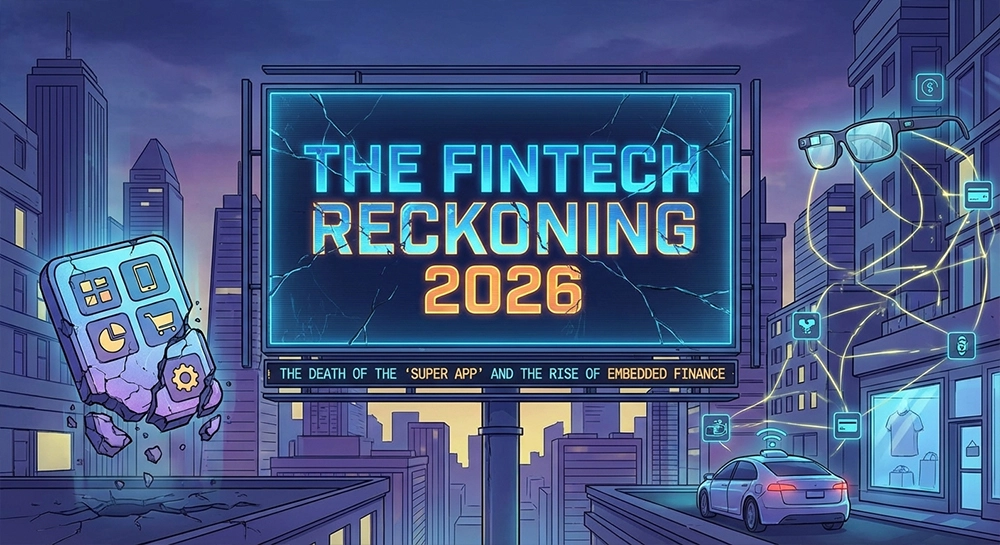
For a decade, the Holy Grail of financial technology was the "Super App"—a single digital interface where a consumer could bank, trade stocks, buy crypto, book travel, and order dinner. Companies like PayPal, Block (Square), and Revolut burned billions chasing this vision, trying to become the WeChat of the West.
In 2026, the verdict is in: The Super App dream is dead.
Consumers didn't want a Swiss Army Knife; they wanted a scalpel. They wanted the best mortgage app, the best trading interface, and the best peer-to-peer payment tool—not a mediocre bundle of all three.
As the dust settles on the "fintech winter" of 2023-2024, a new, more profitable paradigm has emerged: Embedded Finance. Financial services are disappearing into the background of non-financial software. In 2026, fintech isn't a vertical anymore; it's a horizontal layer across the entire economy.
The Vertical SaaS Revolution: Why Your Dentist is a Banker
The biggest winners of 2026 are Vertical SaaS companies—software platforms built for specific industries (restaurants, construction, spas, auto repair).
Take Toast (restaurants) or ServiceTitan (home services). Five years ago, they were software companies charging a monthly subscription. Today, they are fintech powerhouses.
Payments: They process the credit card swipe.
Lending: They see the cash flow data in real-time (better than any bank), so they offer instant working capital loans.
Payroll: They manage the employees, so they offer same-day pay cards and insurance.
By embedding financial products, these companies have tripled their Total Addressable Market (TAM) and increased Net Revenue Retention (NRR) to over 120%. A bank sees a credit score; ServiceTitan sees that you have three profitable plumbing jobs scheduled for Tuesday. Who makes the better loan?
Investment Implication: Stop looking for "fintech stocks" and start looking for software monopolies with hidden fintech engines. Shopify is essentially a bank for e-commerce merchants. Block (Square) has successfully pivoted from a dongle company to the operating system for retail.
The Payments War: Real-Time Rails vs. The Card Duopoly
For 50 years, Visa and Mastercard have been the best business models on earth, collecting a toll on global commerce. In 2026, the moat is finally being breached—not by crypto, but by FedNow and Account-to-Account (A2A) payments.
The U.S. government's instant payment rail, FedNow, has finally reached critical mass adoption. Utilities, landlords, and even some e-commerce giants are incentivizing customers to "Pay by Bank" to avoid the 2.5% card interchange fee.
Adyen and Stripe (still private, but the perennial IPO candidate) have positioned themselves as the neutral arms dealers in this war. Their "orchestration" layers route payments dynamically—if a card fails, try bank transfer; if that fails, try Apple Pay.
The Crypto Maturity: Stablecoins as the New Eurodollar
The real fintech story in crypto is the triumph of Stablecoins. In 2026, stablecoins (USDC, PYUSD) have become the de facto settlement rail for B2B cross-border payments. A manufacturing firm in Vietnam doesn't want to wait three days and pay 4% FX fees to pay a supplier in Brazil. They use USDC on the Solana or Base blockchain—settlement is under 2 seconds, cost is under a cent.
This isn't "Web3" hype; it's "Web2.5" utility. The blockchain is invisible to the user. Coinbase has evolved from a casino for day traders into an infrastructure custodian for BlackRock and a payment rail provider (Base).
Artificial Intelligence in Finance: The End of the Call Center
If you call a bank in 2026, you are not talking to a human. You are talking to a Voice AI so sophisticated that you might not realize it's a bot until it resolves your fraud alert in 30 seconds without putting you on hold.
Klarna shocked the world in 2024 by replacing 700 customer service agents with an AI. By 2026, this is industry standard.
Wealth Management: AI "Co-pilots" allow a single human advisor to manage 500 clients instead of 100.
Underwriting: Large Language Models can read unstructured data—emails, PDFs, contracts. A lender can now underwrite a complex small business loan by simply ingesting the owner's Google Drive.
SoFi and Upstart are the battleground stocks here. Upstart's AI underwriting model, retrained and validated, is taking market share from credit unions that still rely on FICO scores and manual review.
Buy Now, Pay Later (BNPL): The New Credit Card
Regulators tried to kill it. Interest rates tried to kill it. But BNPL is still here, and in 2026, it is eating the credit card industry from the bottom up.
Affirm has emerged as the winner of the BNPL wars. By partnering with Apple and Amazon, they secured the best distribution. But their real pivot was the "Affirm Card"—a physical debit card that lets users retroactively turn any purchase into a loan.
This "decoupling" of credit from the transaction is profound. It threatens the loyalty point moats of Chase and Amex.
The IPO Pipeline: The Class of 2026
After a three-year drought, the fintech IPO window is wide open. The companies going public in 2026 look very different from the SPAC trash of 2021. They are profitable, rule-of-40 growers with real governance.
- Stripe: The behemoth. Likely to be the largest IPO since Alibaba.
- Plaid: The plumbing of fintech. Built a standalone monopoly on bank data connectivity.
- Chime: The survivor of the neobank wars. Built a loyal, profitable user base.
- Revolut: The European champion. Their global "borderless bank" model has finally cracked the U.S. market.
Risk: The Regulatory Hammer
The "wild west" era is over. The CFPB has finalized open banking rules (Section 1033), which is a tailwind for data aggregators like Plaid but imposes heavy compliance costs.
The real risk is Capital Requirements. The "Basel III Endgame" rules are forcing big banks to hold more capital against their loans. While this hurts JP Morgan, it is a massive tailwind for Private Credit Fintechs.
Portfolio Strategy: The "Barbell" Approach
The Safe Harbor (50%): Own the networks. Visa (V), Mastercard (MA), and S&P Global (SPGI). These are cash flow monsters that buy back stock and pay dividends.
The Infrastructure Growth (30%): Own the shovels. Shopify (SHOP), Adyen (ADYEN), Coinbase (COIN), Block (SQ). These companies are building the rails for the next 20 years.
The AI/Disruption Speculation (20%): Upstart (UPST), Affirm (AFRM), SoFi (SOFI). High beta. If AI underwriting truly works at scale, these are 10-baggers. If credit cycles turn against them, they are zeros.
Conclusion: Value Over Hype
The Fintech Reckoning of 2026 was painful but necessary. It washed out the tourists, the fraudsters, and the unprofitable ideas. What remains is a sector that is leaner, smarter, and more integrated into the real economy than ever before.
Money is just data. And the companies that move, analyze, and secure that data are the most valuable industrial enterprises of our time. The "Super App" is dead. Long live the Embedded Financial OS.