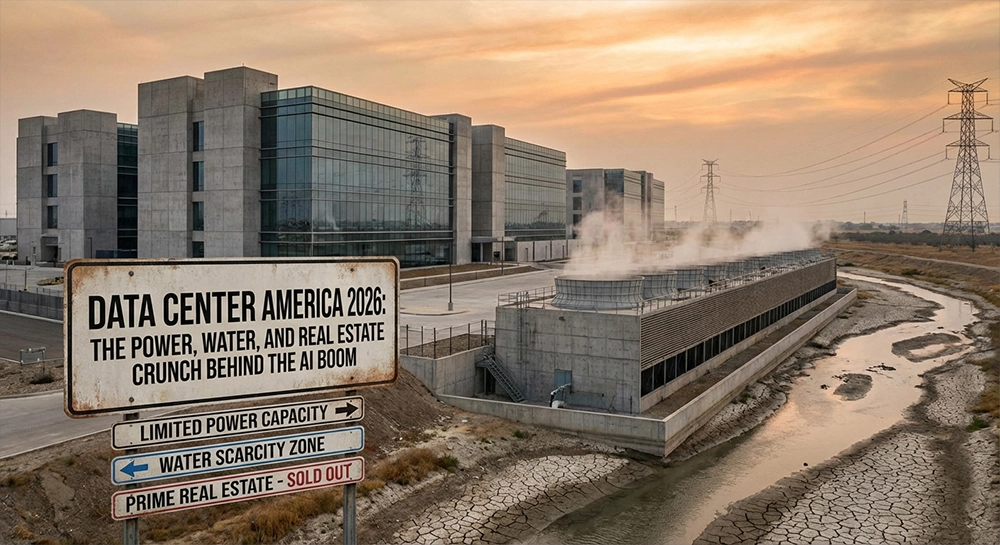
In the U.S. in 2026, the AI trade is no longer just a semiconductor story—it's a physical-economy story about electricity, land, water, and construction capacity. The most investable ripple effects are showing up in grids, energy procurement, and the "picks-and-shovels" companies that make large-scale compute possible.
The new constraint: megawatts
The defining shift of this cycle is that AI growth is colliding with infrastructure limits that can't be scaled at software speed. Data center development is increasingly gated by interconnection queues, transformer availability, and the time it takes to build and energize substations and transmission upgrades.
That turns "time-to-power" into a competitive advantage: the developers and regions that can secure reliable, contracted electricity win the next wave of capex.
This is why 2026 feels different from prior tech booms: the bottleneck is not just compute, it's the ability to operate compute continuously at scale without reliability failures.
As a result, capital is migrating from pure AI equity beta toward the enabling layer—energy, grid modernization, and real assets that sit underneath the digital economy.
Bottlenecks that matter in 2026
The first bottleneck is the grid itself: transmission and distribution capacity, connection rights, and the equipment needed to expand them. Transformer and related electrical equipment shortages extend project timelines and raise delivered costs, which changes underwriting for both data center developers and utilities.
In practice, the scarcity premium doesn't accrue to "AI" as a label; it accrues to whoever controls interconnection, right-of-way, and buildable powered land.
The second bottleneck is construction: data centers are not just warehouses with servers—they are high-spec industrial facilities with specialized cooling, redundancy, and security requirements. Even when financing is available, projects can slip because physical supply chains and contractor capacity are stressed, especially when trade policy and tariffs disrupt procurement cycles.
U.S. tariff dynamics have also pushed companies to rethink sourcing and inventory behavior, which can echo into construction schedules and input prices.
The third bottleneck is energy sourcing strategy. Hyperscalers and large operators increasingly pursue long-term power contracting and dedicated generation solutions to secure round-the-clock supply, which is one reason the "nuclear plus data center" narrative gained mainstream traction heading into 2026.
The market's interest here is pragmatic: nuclear is being discussed as a scalable, low-carbon, 24/7 source that matches the load profile of large compute clusters.
The investment map: who wins, who gets squeezed
The winners in 2026 tend to share one trait: they monetize constraints rather than suffer from them.
On the "monetize constraints" side, grid-linked businesses and power infrastructure suppliers benefit when interconnection and equipment become scarce, because the value shifts toward delivery capability and project execution.
Utilities and grid-adjacent contractors can gain leverage when incremental load growth is large and persistent, particularly when data center demand is concentrated and non-discretionary.
Data center real estate is another clear beneficiary—but the nuance matters. Not all facilities are equal: premium assets are those with secured power, favorable permitting, and proximity to fiber backbones, because those factors reduce time-to-revenue and improve occupancy quality.
In that sense, 2026 data center development starts to resemble regulated infrastructure economics more than classic commercial real estate cycles.
On the other side are businesses that face margin compression from input volatility and policy shocks. Tariffs and supply chain disruptions can push procurement costs higher or increase lead-time risk, which hits contractors and developers operating on tight fixed-price schedules.
There's also a "quiet loser" category: regions that can't deliver power quickly. In 2026, a location can have cheap land and tax incentives, but if it can't interconnect on a workable timeline, the deal may die—or the tenant will demand pricing concessions that reduce the project's return.
That pushes economic activity toward states and utility territories that can move faster on grid upgrades, permitting, and large-load contracting.
Why rates still matter (even in an AI boom)
Many investors treat AI infrastructure as inevitable, which is directionally true—but the speed of the buildout is still rate-sensitive.
Fixed income markets in 2026 are back to being a strategic tool rather than dead weight, and that matters because infrastructure is funded with long-dated capital and refinancing cycles.
Bond market commentary going into 2026 stresses that returns are likely to be driven more by income ("coupon") than dramatic price moves, which is relevant because infrastructure underwriting increasingly emphasizes steady contracted cash flows rather than speculative multiple expansion.
For developers and REIT-like structures, that means the difference between a good and bad year can come down to whether borrowing costs drift lower, stay sticky, or re-accelerate due to inflationary shocks.
And tariffs are one of the mechanisms that can keep inflation pressure alive through goods prices and supply chain frictions, complicating the rate outlook at the margin.
What to watch in 2026
In this environment, the most useful "news checklist" is operational, not thematic.
Watch interconnection queue reform, major transformer and switchgear lead-time normalization, and the cadence of utility large-load approvals, because those determine whether AI capex becomes revenue on schedule.
Track whether procurement costs stabilize or re-spike as trade policy evolves, because tariff-driven volatility can reprice projects that were modeled with outdated assumptions.
Also watch how the market chooses to solve "always-on power." If nuclear-linked strategies gain more contractual traction—through long-term offtake structures, site co-location, or grid-supported baseload planning—that signals a deeper commitment to treating compute as a national infrastructure priority.
And keep an eye on the broader "market playbook" shift that large asset managers have been describing: more attention to AI enablers, infrastructure, and alternatives rather than only headline AI equities.