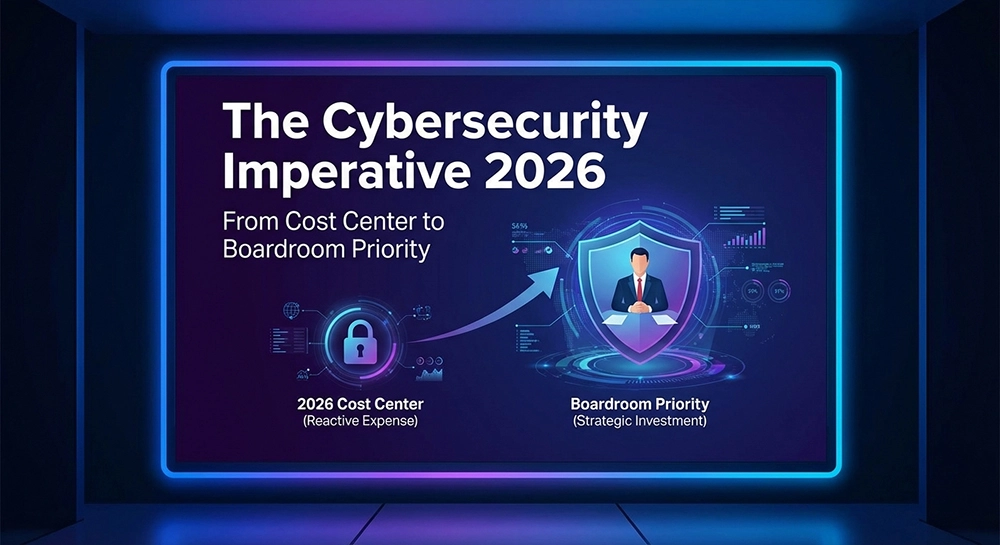
In 2026, cybersecurity is no longer an IT problem; it is a fiduciary duty. The days of treating cyber defense as a "grudge purchase"—buying the cheapest antivirus to tick a compliance box—are over. The threat landscape has evolved from nuisance hackers defacing websites to nation-state actors weaponizing AI to dismantle critical infrastructure.
Ransomware payments hit $2 billion globally in 2025, a 50% jump from the previous year. But the true cost—business interruption, legal liability, reputational ruin—was 20 times higher. The SEC's new disclosure rules, forcing public companies to report material breaches within four days, have ended the era of "sweeping it under the rug."
This existential risk has elevated the Chief Information Security Officer (CISO) to the most critical executive outside the CEO and CFO. In 2026, cybersecurity budgets are the only IT line item immune to cuts.
The AI Arms Race: When the Attackers Use ChatGPT
The defining feature of the 2026 threat landscape is AI-enabled cybercrime.
Deepfakes: Attackers are using generative AI to clone the voices of CEOs, authorizing wire transfers of millions of dollars in "vishing" (voice phishing) attacks. These are virtually undetectable by human ears.
Polymorphic Malware: AI writes malware code that rewrites itself every time it infects a new system, evading traditional signature-based antivirus detection.
Automated Phishing: Attackers use LLMs to craft perfect, personalized phishing emails at massive scale, scraping LinkedIn and social media to make the lure irresistible.
To fight AI, you need AI. This has triggered a massive consolidation cycle. The winners are the "AI-native" platforms—CrowdStrike, Palo Alto Networks, and Zscaler—that ingest trillions of data points daily to train models that can detect anomalies in milliseconds.
In 2026, the only effective defense is autonomous. If a human analyst has to look at an alert, you've already lost.
The Zero Trust Revolution: "Trust No One, Verify Everything"
The old model of "castle-and-moat" security is obsolete. In a world of hybrid work, cloud applications, and IoT devices, there is no perimeter. The perimeter is everywhere.
Identity is the New Perimeter: Okta and Microsoft (Entra ID) are the gatekeepers. If you can't verify who is logging in with absolute certainty (using biometric multi-factor authentication), nothing else matters.
Secure Service Edge (SSE): Zscaler and Cloudflare have moved security from the data center appliance to the cloud. Traffic is inspected instantly before it ever touches a corporate server.
Micro-segmentation: If an attacker gets in, they shouldn't be able to move laterally. Illumio and Akamai use software to wall off individual workloads. If a hacker compromises a printer, they can't jump to the database.
Zero Trust is a decade-long architectural shift. In 2026, enterprises are ripping out legacy VPNs and replacing them with Zero Trust Network Access (ZTNA).
The Platformization of Security
CISOs are drowning in "tool sprawl." The average enterprise has 60+ different security tools that don't talk to each other. The dominant trend of 2026 is Platform Consolidation.
Palo Alto Networks: The aggregator king. They have stitched together network security, cloud security (Prisma), and security operations (Cortex) into a unified fabric.
CrowdStrike: Expanded from endpoint protection to identity protection, cloud workload protection, and vulnerability management. Their single-agent architecture is the gold standard.
Microsoft: The "good enough" giant. For mid-market companies, Microsoft's built-in security suite (E5 license) is often sufficient and practically free since they are already paying for Office 365.
Cloud Security: Defending the Invisible
CNAPP (Cloud-Native Application Protection Platforms) is the hottest sub-sector. Companies like Wiz (the fastest-growing software startup in history) and Sysdig allow security teams to scan their entire cloud environment instantly, identifying misconfigured buckets, over-privileged users, and unpatched containers.
The line between "DevOps" and "Security" has blurred into DevSecOps. Code is scanned for vulnerabilities before it is even compiled.
Operational Technology (OT) Security: Protecting the Physical World
The scariest breaches aren't data theft; they are kinetic. Attackers hacking a water treatment plant. Ransomware shutting down a pipeline. Malware disabling safety systems in a refinery.
This is Operational Technology (OT) security. Tenable, Nozomi Networks, and Dragos are the leaders here. With geopolitical tensions rising, governments are mandating strict OT security standards for critical infrastructure providers.
Valuations: High Quality, High Premium
The sector trades at 10-12x forward revenue. Is it a bubble? Unlikely. Cybersecurity is a deflationary force against an inflationary risk. Spending $1 million on CrowdStrike is cheaper than a $50 million ransomware payout. Demand is inelastic.
- CrowdStrike (CRWD): Premium due to best-in-class retention and "Rule of 60" financials.
- Palo Alto Networks (PANW): The "blue chip" value play. Lower multiple, immense cash flow.
- Zscaler (ZS): The pure-play Zero Trust bet. High growth, high volatility.
- CyberArk (CYBR): The leader in Privileged Access Management. Consistent 20% grower.
The Talent Crisis: 4 Million Unfilled Jobs
The global shortage of 4 million cybersecurity professionals drives demand for MSSPs (Managed Security Service Providers). Arctic Wolf and Secureworks provide "SOC-as-a-Service," monitoring alerts and responding to threats for a monthly fee.
Investment Thesis 2026
The cybersecurity thesis is simple:
- Threats are compounding (AI + Geopolitics)
- Attack surface is expanding (Cloud + IoT + Remote Work)
- Regulation is mandating spending (SEC + EU NIS2)
This creates a structural tailwind that will last for the rest of the decade.
The "Cyber 5" Portfolio:
- CrowdStrike (Endpoint/AI)
- Palo Alto Networks (Platform)
- Zscaler (Network/Zero Trust)
- Cloudflare (Internet Infrastructure)
- CyberArk (Identity/Privilege)
In 2026, cybersecurity is the immune system of the digital economy. Without it, the host dies. Investing in the immune system is always a good bet when the viruses are getting smarter.