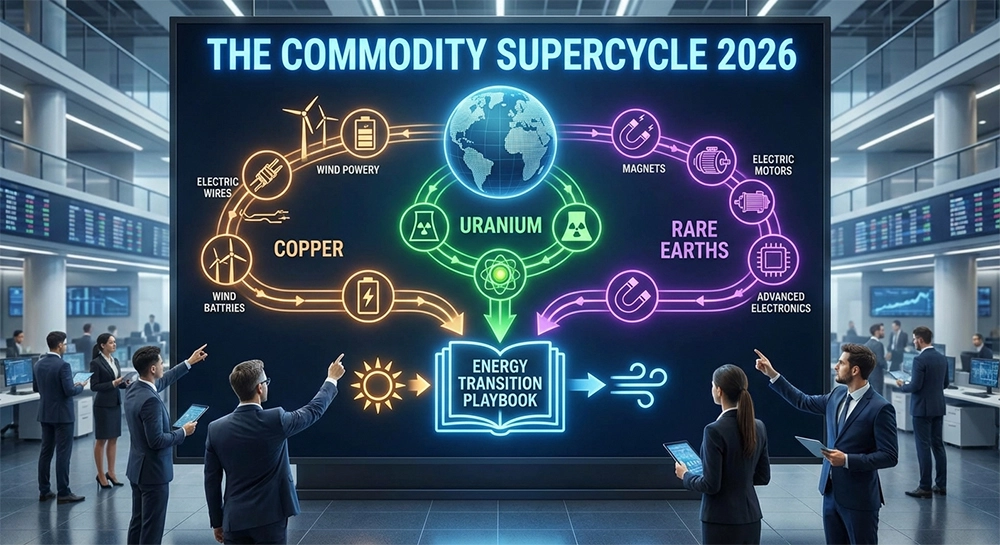
While investors obsess over AI stocks and rate cuts, the real story of 2026 is unfolding in commodity pits, mining camps, and futures exchanges. A structural bull market in critical materials—copper, uranium, lithium, and rare earth elements—is accelerating as the twin forces of energy transition and artificial intelligence collide with decades of underinvestment. This isn't your grandfather's commodity cycle. It's a multi-decade infrastructure buildout where supply cannot catch demand, and prices have nowhere to go but up.
The Perfect Storm: Demand Explosion Meets Supply Drought
For the first time since the China-driven supercycle of 2003-2011, commodity fundamentals are screaming scarcity. But unlike that era—driven by construction booms and consumer goods—the 2026 cycle is powered by three irreversible mega-trends:
Electrification at Scale: The International Energy Agency estimates global electricity demand will grow 75% by 2040, with renewables, EVs, and data centers driving the surge. Every electric vehicle requires 4x the copper of an internal combustion vehicle. Every megawatt of wind turbines demands 3 tons of copper, 0.5 tons of rare earths, and 15 tons of steel. The math is brutal: to meet Paris Agreement targets, humanity needs to mine more copper in the next 25 years than in all of recorded history.
AI Infrastructure Appetite: A single hyperscale data center consumes 200-500 megawatts—equivalent to powering 200,000 homes. NVIDIA's H200 GPU clusters require advanced cooling systems using specialized copper alloys and thermal management materials. The semiconductor supply chain alone will consume 8 million metric tons of copper annually by 2028, double 2020 levels.
Nuclear Renaissance: With 15 new reactors under construction in the U.S. and 60+ globally, uranium demand is set to exceed 200 million pounds annually by 2028. Yet primary mine production sits at just 140 million pounds. The deficit has been bridged by depleting Cold War-era stockpiles—inventories that are now functionally exhausted.
Copper: The "Dr. Copper" Diagnosis Is Bullish
Copper has earned its nickname as "Dr. Copper" for its uncanny ability to diagnose global economic health. In January 2026, copper futures broke through $5.20/lb—a 12-year high—and institutional positioning suggests this is just the beginning.
Supply Side Paralysis
Global copper mine production peaked in 2024 at 22 million metric tons and has plateaued. Major miners face cascading challenges:
Ore Grade Decline: Average copper ore grades have fallen from 1.2% in 2000 to 0.6% today. Miners now process twice the rock for the same output, driving costs up 140% over two decades. Chile's Escondida, the world's largest mine, reports ore grades below 0.5%—barely economic at current operating costs.
Permitting Gridlock: New mine development timelines stretch 15-25 years from discovery to first production. Environmental opposition, community resistance, and regulatory complexity have killed $120 billion in projects since 2015. Resolution Copper in Arizona—holding 40 billion pounds—remains tied up in federal review after 20 years.
Capital Flight: After the 2011-2015 commodity crash, mining capex collapsed 60%. Major producers prioritized dividends over exploration. The result: a development pipeline incapable of meeting 2030 demand. Wood Mackenzie projects a 10 million ton annual deficit by 2035—50% of current consumption.
Demand Side Acceleration
Renewable energy installations are running 30% ahead of conservative forecasts. Offshore wind, which requires 8-15 tons of copper per megawatt (vs. 3-4 tons for onshore), is exploding in Europe and Asia. China's grid modernization alone demands 5 million tons annually through 2030.
Electric vehicle adoption crossed the critical 15% market share threshold in Q3 2025—the inflection point where S-curve adoption accelerates exponentially. Ford's $60 billion EV capex plan through 2028 assumes 2.5 million tons of additional copper demand.
The pricing mechanism is clear: Goldman Sachs forecasts copper at $6.50/lb by Q4 2026, with potential spikes to $8/lb if Chinese stimulus reignites infrastructure spending. At $8, marginal cost producers in Africa and South America become viable, but even that supply takes 5-7 years to reach market.
Uranium: The Sleeping Giant Awakens
If copper is the nervous system of the energy transition, uranium is the baseload power source that makes it possible. After a lost decade of sub-$30/lb prices following Fukushima, uranium has surged past $95/lb—and the rally is just beginning.
The Supply-Demand Scissors
Global reactor fleet: 440 operating reactors consuming 180 million pounds annually. Primary mine production: 140 million pounds. The gap has been filled by recycled weapons-grade material from Russia and depleted Western stockpiles. That bridge is burning.
Russia's Rosatom supplied 35% of Western enriched uranium before geopolitical fractures. The U.S. banned Russian imports in December 2024, forcing utilities to compete for dwindling non-Russian supply. European utilities face contract rollovers in 2026-2027 with no Russian optionality—creating a bidding war for Kazakhstan, Canada, and Australian production.
Kazakhstan, the world's largest producer at 45% market share, announced production will plateau at current levels through 2028 due to labor shortages and aging infrastructure. Cameco, Canada's flagship producer, reports its Cigar Lake mine operating at maximum capacity with no expansion potential.
The Nuclear Revival Is Real
Fifteen U.S. reactors under construction or restart (Three Mile Island reactivation approved). France reversed its nuclear phaseout, greenlighting six new EPR reactors. Poland, Netherlands, and Czech Republic announced first-ever nuclear programs. Even Japan is restarting its fleet—24 reactors approved for operation by 2027.
Small Modular Reactors (SMRs) represent the next wave. NuScale, TerraPower (Bill Gates-backed), and Rolls-Royce have secured $18 billion in orders from utilities and tech companies. Microsoft's 20-year PPA with Constellation Energy for dedicated nuclear capacity signals hyperscaler commitment.
The math: each 1GW reactor requires 400,000 pounds of uranium annually. With 60+ reactors under construction globally, incremental demand exceeds 20 million pounds—14% of current supply—before accounting for SMRs.
Spot uranium already trades at $95/lb, but long-term contract prices (the real market) lag at $68/lb. As utilities lock in multi-decade supply, expect convergence toward $120-150/lb—the incentive price for tier-2 mines in Africa and Australia.
Rare Earth Elements: China's Monopoly Under Siege
Rare earths—17 obscure elements critical to magnets, batteries, and defense systems—represent the ultimate supply chain chokepoint. China controls 85% of global refining capacity, creating acute geopolitical risk as U.S.-China tensions intensify.
Strategic Vulnerabilities Exposed
Neodymium and dysprosium, essential for permanent magnets in EV motors and wind turbines, trade at multi-year highs. Praseodymium, used in high-strength glass and catalytic converters, has surged 60% since 2024. Terbium and europium, critical for displays and lasers, face chronic deficits.
U.S. and allied nations import 95% of processed rare earths from China. The 2025 Export Control Act granted Beijing veto power over rare earth shipments to strategic industries. When China briefly restricted exports in December 2025 (in retaliation for semiconductor sanctions), EV and defense contractors faced production delays.
The Western Response: Too Little, Too Late?
MP Materials' Mountain Pass mine in California produces 15% of global rare earth concentrate but ships it to China for processing. The $700 million separation facility under construction won't be operational until Q1 2027.
Lynas Rare Earths (Australia) operates the only non-Chinese heavy rare earth facility but faces capacity constraints. Texas-based USA Rare Earth received a $288 million Department of Defense grant for a processing hub in Oklahoma, targeting 2028 startup.
The bottleneck isn't mining—it's separation chemistry. China spent 30 years perfecting environmentally hazardous refining processes Western regulators won't permit. Establishing parallel supply chains requires $15-25 billion in capex and 7-10 years. The West is at least a decade behind.
Investment thesis: Strategic stockpiling (U.S. Defense Logistics Agency tripled rare earth reserves in 2025) and supply chain mandates (DOD procurement preferences) will support elevated prices through 2030. Expect neodymium to test $150/kg (vs. $90 today) as EV production scales.
Lithium: The Correction Before the Storm
Lithium stands apart as the commodity that already experienced its "2026 rally" in 2021-2022, then crashed 80%. Prices bottomed at $13,000/ton in November 2025 and have recovered to $22,000—well below the $80,000 peak but stabilizing as supply discipline returns.
Oversupply Narratives Are Overstated
Yes, Australian spodumene mines flooded the market in 2024-2025. Yes, Chinese battery recycling is ramping faster than expected. But structural demand remains intact: BloombergNEF projects 50 million EVs sold annually by 2030 (vs. 14 million in 2025). Each vehicle requires 8-10kg of lithium carbonate equivalent.
The correction has been healthy, clearing speculative froth and forcing high-cost producers offline. Chilean SQM and Albemarle shut 30% of capacity in 2025. Australian junior miners filed bankruptcy at a 15-year high. Surviving producers enter 2026 with fortress balance sheets and pricing discipline.
The Next Upleg: Solid-State and Grid Storage
Solid-state batteries, entering mass production in 2027-2028 (Toyota, QuantumScape), consume 20% less lithium but enable range and safety breakthroughs that accelerate EV adoption. The net effect: higher total lithium demand despite per-unit efficiency gains.
Grid-scale storage is the stealth demand driver. Utilities installing 400GWh of battery storage by 2030 (4x current levels) to balance intermittent renewables. Each gigawatt-hour consumes 800 tons of lithium carbonate.
Price outlook: Stabilization at $20-25,000/ton through 2026, with renewed upside to $40,000 by 2028 as EV penetration crosses 25% market share and supply discipline holds.
Portfolio Construction: How to Play the Supercycle
Commodity investing requires sector-specific strategies:
Copper Majors for Core Exposure: Freeport-McMoRan, Southern Copper, and Teck Resources offer leveraged copper exposure with dividend support. These trade at 6-8x EBITDA vs. 10-year averages of 9x—room for multiple expansion plus operational gearing to price increases.
Uranium Specialists for Asymmetric Upside: Cameco and Kazatomprom dominate production but trade at full valuations. The alpha lies in developers: Denison Mines (Wheeler River project), Energy Fuels (U.S. production restart), and NexGen Energy (Arrow deposit—highest grade globally). These offer 3-5x return potential on uranium normalization to $120/lb.
Rare Earth Strategic Plays: MP Materials benefits from geopolitical tailwinds and Pentagon contracts. Lynas Rare Earths offers Australian regulatory stability. Speculative allocation to USA Rare Earth (pre-production, high risk) captures potential government offtake agreements.
Lithium Recovery Trade: Albemarle and SQM bottomed at 4x EBITDA—historical trough valuations. As lithium stabilizes above $20,000, these revert to 8-10x multiples, implying 60-80% upside plus restructured dividends.
Physical Exposure via ETFs and Futures: COPX (copper miners), URA (uranium), REMX (rare earths), and LIT (lithium) provide diversified exposure. Sophisticated investors use CME copper futures and Sprott Physical Uranium Trust for direct commodity beta.
Risk Management: What Could Go Wrong
Demand Destruction: Recession fears persist. If U.S. GDP contracts, industrial metals face 15-20% drawdowns. Mitigation: structural demand (EVs, data centers) is less cyclical than traditional construction.
Technology Disruption: Breakthrough substitutes (graphene superconductors, fusion energy) could obsolete today's materials. Probability: low through 2030. Copper and uranium have no viable large-scale alternatives.
China Dumping: Strategic reserve releases or overcapacity exports could flood markets. Precedent: 2015 aluminum crash. Countermeasure: U.S. tariffs and anti-dumping duties provide price floors.
Geopolitical Shocks: Mining nationalism (resource expropriation), sanctions, or conflicts disrupt supply chains. Hedge: geographic diversification across jurisdictions.
The 2026 Commodity Playbook
This supercycle isn't driven by Chinese construction or speculative fervor. It's anchored in physics: the materials required to decarbonize energy systems and power AI infrastructure simply don't exist in sufficient quantities at current prices.
The setup mirrors early 2000s but with more durable catalysts:
- 2003-2011 Cycle: China urbanization, 8-12 year run
- 2026-2035 Cycle: Global electrification + AI, 10-15 year runway
Expected returns: 15-25% annualized for diversified commodity equity portfolios, with individual names offering 3-5x potential on supply shocks.
The energy transition is real. AI is insatiable. Supply chains are broken. Commodity investors positioning now are buying the picks and shovels for the 21st century's industrial revolution—except this time, the shovels are made of copper, powered by uranium, and held together with rare earths.
Wall Street will eventually wake up. By then, the easy money will be gone.